
To plan an efficient operation , you need to understand that hybrid fleet management appears as the ideal bridge to the Brazilian reality.
In a scenario where charging infrastructure is still under development, hybrid models offer the necessary autonomy for your teams without the company compromising its commitment to reducing costs and emissions.
The intelligence behind this transition lies in the clear view of the data: it is necessary to unite fuel consumption and mileage information in a single environment to ensure that your cost per kilometer (R$/km) is measured fairly, comparing new and old vehicles in a balanced way.
You will take this with you:
The hybrid vehicle functions as a safe transition solution. for commercial fleets seeking sustainability without the risk of lack of autonomy;
KPIs for mixed fleets require you to look at integrated metrics., such as combined consumption and the rate of use of electric mode;
Golfleet Smart offers the clarity needed to integrate the data. Fuel and driver support, ensuring a return on investment.
Browse the content
What defines high-performance hybrid fleet management?
KPIs for hybrid fleets: what to measure to guarantee ROI?
TCO of hybrid fleets: a real cost comparison.
Telemetry for hybrid vehicles: The intelligence behind the data.
Challenges of implementation and how to overcome them.
Operational intelligence as the engine of transition.
What defines high-performance hybrid fleet management?
Having a hybrid fleet isn't just about swapping out the cars ; it's about changing the way you look at your spreadsheet.
For those who manage light fleets, performance now depends on knowing where each technology shines.
It's not enough to just put the hybrid on the road: you need to understand how fuel economy behaves in different route profiles, whether in stop-and-go city traffic or on highway trips.
The hybrid model is gaining traction because it is resilient and addresses concerns about the lack of chargers.
However, this mix of vehicles brings a challenge: the need to track spending from different sources.
Successful hybrid fleet management utilizes technology to ensure vehicles operate in their most economical range, transforming efficiency into a real cost-reduction strategy.

KPIs for hybrid fleets: what to measure to guarantee ROI?
When you put the first hybrid in the fleet, the old kilometers per liter (km/L) indicator stops telling the whole story.
In hybrid fleet management , your indicators need to show how the combustion engine and the electric component are interacting.
To ensure the investment pays off and the ROI materializes, you should focus on hybrid fleet KPIs that provide this integrated view.
Energy cost per km (R$/km)
This is the master metric . Instead of getting lost in complex calculations, focus on what comes out of the cash flow.
The cost per kilometer should be analyzed in a unified way , allowing for a comparison of the overall efficiency of the hybrid against conventional models.
If the cost per kilometer (R$/km) of the hybrid is not lower than that of the combustion engine model on urban routes, the operation needs adjustment.
Efficiency by route profile
Since the focus of the hybrid is fuel economy in urban traffic, the key is to look at the fuel consumption figures.
The hybrid should have a higher average fuel consumption (km/L) in the city. If the consumption is the same as a regular car, it means that the driver is not taking advantage of the technology or the chosen route does not favor the hybrid system.
Reduction of emissions (CO2)
Monitoring how much your fleet has reduced fuel consumption is the most direct way to measure sustainability.
Having these records allows you to demonstrate the positive impact of the change to management, consolidating the image of a modern and efficient operation.

Total Cost of Ownership (TCO) of hybrid fleets: a real cost comparison.
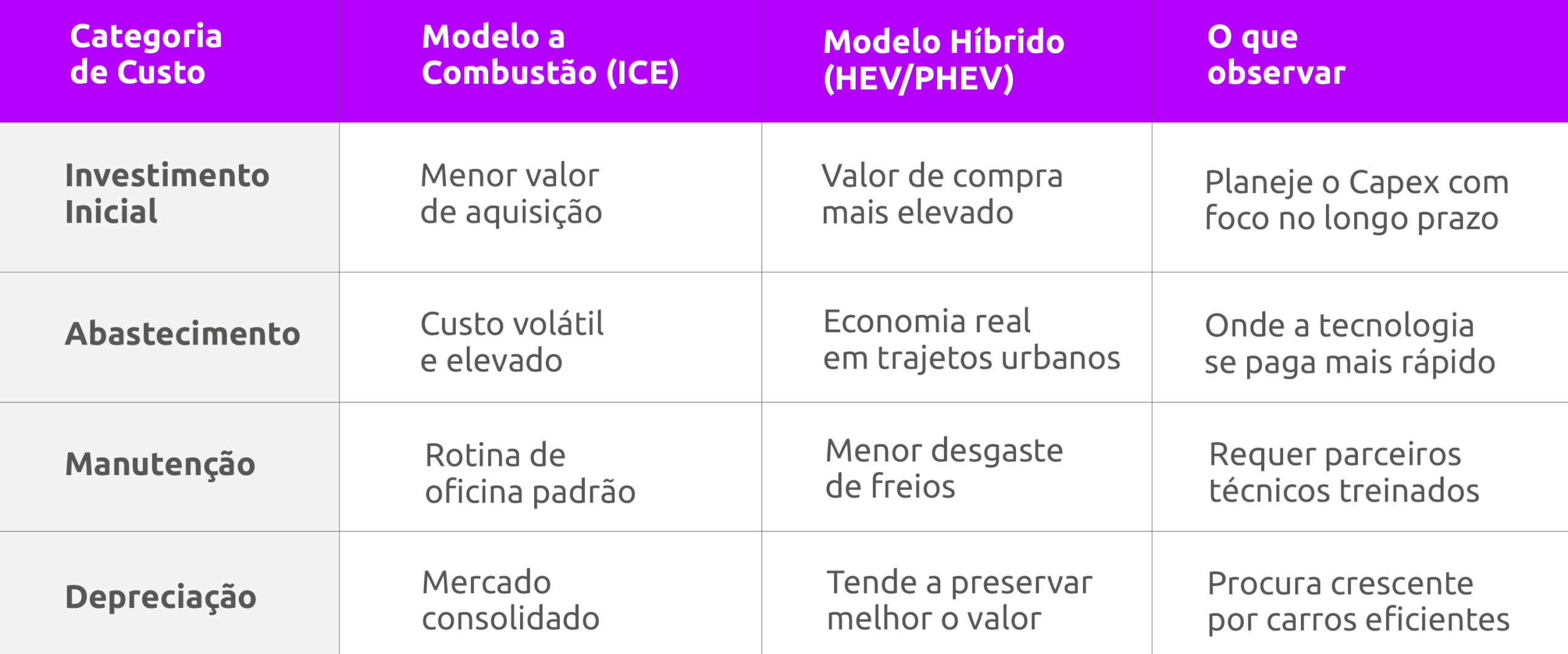
The TCO (Total Cost of Ownership) of hybrid fleets is what will determine if the numbers add up when it's time to renew your light vehicle fleet.
Although the purchase price is higher, experience with commercial fleets shows that day-to-day savings tend to offset the initial investment in the medium term, especially in urban settings.
Telemetry for hybrid vehicles: the intelligence behind the data.
The Golfleet Smart system acts as the necessary layer of intelligence for monitoring driving behavior.
Since hybrid cars rely heavily on how the driver uses braking to regenerate energy, driver support becomes key to success.
Operational intelligence provides clarity on:
- Efficient driving: guide the driver to avoid sudden accelerations, allowing the hybrid system to work for longer.
- Driving events: Identify braking and speeding that reduce the efficiency of any engine.
- Performance by region: understand which routes are bringing the best financial return with hybrid models

Challenges of implementation and how to overcome them.
The journey of managing hybrid fleets in Brazil still faces challenges related to driver culture.
Field personnel need to understand that driving a hybrid requires a different driving style for the fuel economy to truly materialize.
When employees understand the purpose , they become your greatest ally in reducing costs and preserving lives.
To make this management even more efficient, Golfleet's fuel module integrates with fuel cards , automating data collection.
This ensures that your cost per kilometer is calculated accurately . If your operation uses reimbursements or spreadsheets, Golfleet Smart makes it easy to upload this data to generate unified performance reports.
Operational intelligence as the engine of transition.
Hybrid fleet management is the strategic choice for modernizing operations while remaining grounded.
By combining the power of a conventional engine with the efficiency of electric technology , you get the best of both worlds.
The secret is not to fly blind: use the data from Golfleet Smart to transform the complexity of a hybrid fleet into decisions that protect your cash flow and your team.
Have you analyzed whether the cost per kilometer of your current fleet would justify introducing hybrid models on your most congested routes?
Before you go, here are the answers to the main questions about hybrid fleet management.
Is it worth replacing the combustion engine fleet with a hybrid one now?
The investment is usually worthwhile if your vehicles are driven extensively in urban areas and if the company is pursuing fleet decarbonization goals. The focus should be on the Total Cost of Ownership (TCO) over a 3- to 5-year cycle, where fuel savings help offset the purchase price.
What is the difference between maintaining a regular vehicle and a hybrid vehicle?
Hybrid vehicles typically require less from the physical braking system due to electric regeneration. However, they require partners with technicians trained in high-voltage systems to ensure that preventative maintenance is performed safely.
How do KPIs for hybrid fleets help control costs?
They allow you to unify fuel consumption and performance data for the entire fleet in one place. This eliminates the need to look at different reports for regular and hybrid cars, making it easier to compare costs and monitor vehicle energy efficiency.
What is combined fuel consumption in hybrid fleet management?
Combined fuel consumption is the metric that integrates liquid fuel consumption (liters) with electricity consumption (kWh). This perspective is essential for understanding the real cost per kilometer driven and validating the ROI of the energy transition.