Talking about data integration in fleet management means talking about seeing the operation from end to end , without gaps. In many companies, the routine is still similar: one spreadsheet for usage control, another for maintenance , driver information scattered across emails and WhatsApp conversations.
Golfleet's proposal is precisely to turn this around: using technology and data integration in fleet management to connect systems , people , and decisions . Check out the content we've prepared for you!
Summary
Data integration in fleet management allows you to see the operation as a whole.It reduces rework and increases the quality of decisions.
With Golfleet's fleet management systemTelemetry, indicators, reports, and dashboards are all connected in a single environment.
When data becomes feedback, gamification With a strategic vision, the fleet begins to generate daily learning.
Browse the content.
Data integration in fleet management
Golfleet fleet management system: where the data is located.
Fleet performance indicators: what to track first
Real-time feedback for drivers: data that translates into immediate correction.
Data integration in fleet management, drivers, and managers.
Data integration in fleet management
When data doesn't communicate with each other , day-to-day management becomes cumbersome . The lack of data integration in fleet management also creates a dangerous feeling : that "everything is under control," when in reality the view is only partial.
A manager might think the fleet is performing well because there haven't been any major incidents in the month, but by cross-referencing risk events , vehicle usage , and work hours , they might discover that the risk is merely hidden.
By integrating data , the logic changes. Information that was previously scattered becomes part of a single picture.
- Vehicles
- drivers
- Routes
- Days
- Driving events
- Maintenance occurrences
Everything is accessible in a central environment , allowing you to see behaviors, patterns, and exceptions.
Data integration in fleet management is no longer an abstract desire but a concrete reality that reduces rework , improves information quality , and, most importantly, creates a basis for better decisions.
It's not about having more data. It's about having the right data , in the right place , at the right time , available for use.

Golfleet fleet management system: where the data is located.
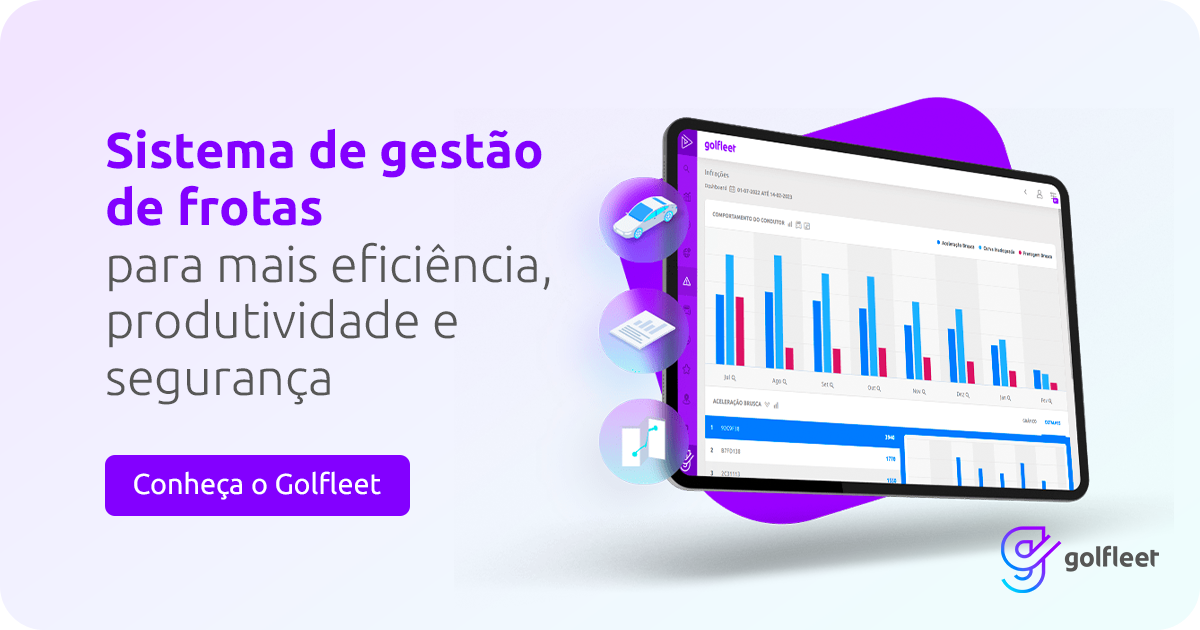
The Golfleet fleet management system positions itself as software designed to centralize all operational information.
Instead of living in "islands," information flows into a single environment where managers and drivers speak the same language.
In practice, this means that the system records :
- The actual use of vehicles (route, schedules, stops, mileage);
- Driving behavior (speeding, sudden braking and turns, risky events);
- The relationship between driver, vehicle e cost center;
- The fleet's history over time.allowing for comparison of time periods and tracking of progress.
When the team starts working from this integrated perspective , a lot changes. That discussion based on "I think" gives way to conversations anchored in data.
Fleet performance indicators cease to be mere numbers on a spreadsheet and become a benchmark for decisions regarding training , vehicle replacement , policy adjustments , and prioritization.
Telemetry based on data integration in fleet management.
At the heart of this structure is fleet management telemetry . It's what captures what's happening with the vehicle on the road.
Using telemetry, the Golfleet system can record how the driver drives , where they go, how long they remain stopped , which risky events are repeated, and in what context.
This constant data capture forms the raw material for data integration in fleet management. Instead of relying on the driver's memory or anecdotal reports, the manager gains an objective trail of events.
In many scenarios, video telemetry comes in as a reinforcement , bringing image and context to complement the data.
The result is a much more complete picture of the operation : it's not just "there was a speeding violation," but "on which road, in which situation, with which driver, how often." From there, it becomes much easier to understand what is the exception and what is the norm.
Fleet performance indicators: what to track first
With the data house organized, the possibility arises to work with indicators in a mature way.
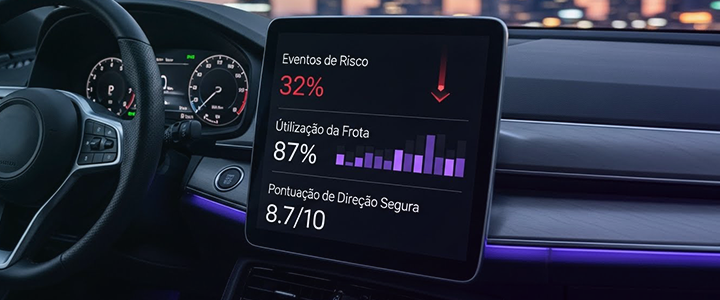
Fleet performance indicators are a way to translate the reality of the operation into numbers that can be tracked over time.
Here are some examples of how the Golfleet fleet management system helps to monitor:
- Risk event levels per driver, vehicle or region
- Scgold safe driving, consolidating different types of behavior;
- Fleet utilization, showing idle or overloaded vehicles
- Journey and usage patterns during peak hours
These indicators tell stories that are essential for fleet management : the driver who improved, the team that reduced the volume of serious incidents, the unit that needs extra support because it remains above the average risk level.
Data integration in fleet management is what ensures that these numbers are consistent and comparable, month after month.
Fleet management reports: recording operational learnings.
While indicators show only a part of the process, fleet management reports show the entire process . They allow you to look back, understand what has changed, which actions worked, and where there are still areas for improvement.
In the Golfleet fleet management system , these reports are generated automatically , based on the integration of data in fleet management.
Management no longer needs to manually compile spreadsheets: they can access or schedule reports that already show the evolution of performance indicators, comparisons between periods, and consolidated data by driver, vehicle, or unit.
This historical record is fundamental for transforming data into knowledge . The company stops discussing only how the month went and starts discussing how we are evolving throughout the year.
Smart dashboards: strategic fleet overview in a single panel.
While reports aid in deeper analysis, dashboards become an everyday tool.
With data integration in consolidated fleet management, the Golfleet system offers dashboards that show, in just a few seconds, how the fleet is performing at any given moment.
Ultimately, it's the integration of data in fleet management that makes this possible . Without integration , the dashboard becomes incomplete information . With integration, it becomes a reliable control panel to guide the operation.

Real-time feedback for drivers: data that translates into immediate correction.
All this data only makes sense if it helps those behind the wheel to drive better and more safely . Therefore, an important part of the Golfleet system's proposal is to transform information into useful feedback for the driver.
Based on fleet performance indicators, the Golfleet system makes it possible to create driving rankings , highlight drivers who have reduced incidents the most, and recognize teams that have managed to keep the fleet within safety and efficiency standards.
These acknowledgments can be formal , in internal campaigns , or simpler , in day-to-day communications.
When drivers begin to see data as a way to demonstrate their progress, and not just as a tool for accountability, engagement reaches a new level.
Data integration within the fleet is increasingly seen as an asset , not a threat. This shift in perception is an essential step towards establishing a culture of safety and results.
Data integration in fleet management, drivers, and managers.
Ultimately, what the Golfleet system delivers is not just technology. It's a different way of looking at fleet management. Data integration in fleet management creates a scenario where:
- Managers have indicators.reliable reports and dashboards to help you make decisions.
- Drivers receive feedback and recognition. based on facts
- The company is able to keep track.Month by month, we are moving towards security and... efficiency.
Each piece of data collected, each report generated, each conversation based on indicators becomes another brick in this daily learning process.
The fleet ceases to be a difficult-to-understand cost center and becomes a living organism, capable of teaching the organization how to operate better.
If you, as a manager, feel that your operation already has information , but you haven't yet been able to transform that into a clear vision and a routine for improvement , the next step is natural: understand how a platform like Golfleet can help integrate fleet data and get drivers and managers on the same page.
Simply speak with one of our specialists to see, in practice, how data integration, telemetry, performance indicators, and fleet reports can be adapted to the reality of your operation.
Before you go, here are some answers to frequently asked questions about data integration in fleet management.
What is data integration in fleet management?
It is the ability to bring together, in a single system, information on vehicles, drivers, routes, journeys, risk events, and costs.
What are the main benefits of integrating fleet data?
Less rework, more reliable indicators, consistent reports, and faster decisions. Furthermore, integration makes it easier to see risk patterns, cost-saving opportunities, and the evolution of drivers and units over time.
What are fleet performance indicators and why do they matter?
These are metrics that translate fleet behavior into numbers: level of risk events, safe driving score, vehicle usage, journey times, among others.