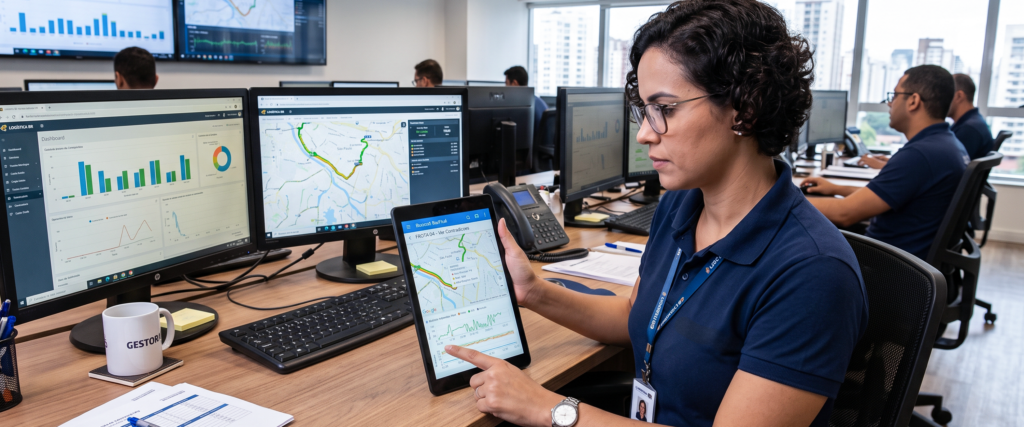
In the routine of an operation, a difficult question often arises: what really happened to the vehicle? Was there a collision, misuse, irregular refueling, route deviation, or an attempt to manipulate the interpretation of the facts? When the company relies solely on reports , memory , or manual records , the investigation becomes slower , more fragile , and prone to conflicts.
It is precisely at this point that telemetry changes the level of fleet management ; it helps to reconstruct the context. With route data , behavior , refueling patterns , driver identification , and event logs , the company gains a stronger basis for investigating incidents, separating indications from evidence, and supporting a claim with much more consistency.
Executive summary
Telemetry helps to contest claims with evidence. By cross-referencing trajectory, speed, driver behavior, and impact record to reconstruct the context of the incident.
Telemetry helps identify fleet fraud. by revealing inconsistencies between fuel supply, consumption, unscheduled stops, and actual vehicle usage.
Driver identification strengthens It eliminates audits and disputes because it links each use to a specific driver, reduces uncertainty, and improves operational traceability.
Browse the content
Why unproven claims become a bigger problem
What data does telemetry provide for investigating incidents?
How to investigate accident suspicions with more context.
Where fraud typically occurs in fleet management.
How to cross-reference supply, route, and consumption to find inconsistencies.
Why identifying the driver strengthens the appeal.
How to structure a more consistent dispute process
Telemetry as a basis for auditing, prevention, and decision-making.

Why unproven claims become a bigger problem
It is common for the greatest strain on operations after an incident in the fleet to be the difficulty in proving what happened.
Without operational visibility , investigations often rely on conflicting accounts, approximate times, and poor traceability. This creates opportunities for rework, internal friction, poorly substantiated challenges, and hasty decisions.
The impact is felt on several fronts:
- Difficulty in validating the dynamics of a accident
- Uncertainty about who was driving
- Low capacity to detect misuse. of the vehicle
- Questions about deviations, stops e supplies outside the norm
- Audits slower and less reliable
When a company cannot prove the context of an event, it loses time to react, room to contest, and predictability to correct the operation.
What data does telemetry provide for investigating incidents?
Using telemetry to dispute claims and fraud means cross-referencing operational signals to assemble a more accurate reading of the event.
In everyday life, this involves observing information such as:
- Route taken
- Speed and behavior of the vehicle during the period of the incident
- Unscheduled stops
- Route deviations outside the norm
- Compatibility between consumption, supply e actual use of the vehicle
- Driver identification linked to usage
- Impact records and suspected collision
When these elements are analyzed together, management stops operating in the realm of assumption. Instead of merely reacting to the problem, it begins to investigate with rigor.

How to investigate accident suspicions with more context.
A suspected accident is not always accompanied by clarity . Sometimes there is an inconsistent report . In some cases, there is a discrepancy between what was reported and what the vehicle actually registered.
With event analysis tools , the investigation becomes more robust. In potentially impactful occurrences, it's possible to rely on records that help to understand the investigated moment in greater depth.
In this scenario, the Fleet Rec module enhances analysis capabilities by automatically generating an event when an impact is suspected. From there, the operation can examine relevant incident data , such as speed and lateral , vertical , and longitudinal accelerations , as well as verify the vehicle's path on the map, analyze graphs, and access a 3D replay of the seconds preceding the impact.
This type of reading changes the quality of the investigation because it helps to answer objective questions:
- There was evidence consistent with a collision.
- What was the vehicle's dynamic? immediately before the event
- The account matches the recorded behavior
- The apparent severity of the event makes sense given the data.
This does not eliminate the need for human analysis , but it reduces guesswork and strengthens decision-making.
Where fraud typically occurs in fleet management.
When discussing fleet fraud , it's common to think of staged accidents or misuse of vehicles . However, a significant part of the problem lies in less visible irregularities, especially in fuel consumption.
Fuel theft can occur through altered records , fuel dispensing incompatible with vehicle use, or even through physical methods such as improper tampering with tanks . In operations with little oversight, this type of distortion can go unnoticed for a long time.
Therefore, challenging fraud also depends on monitoring operational routines, patterns, and consistency.
Some signs deserve attention:
- Incompatible supplied values with the vehicle's consumption
- Unscheduled stops
- Route deviations outside of the common
- Recurring disagreements between fuel supply records and vehicle data
- Suspicious behavior in use
The most important point here is simple: fraud rarely appears in isolation; it usually leaves traces.
How to cross-reference supply, route, and consumption to find inconsistencies.
A mature fleet management system doesn't view refueling as an isolated event. It compares this record within the operational context of the vehicle.
If refueling occurred at an unauthorized location , at an unusual time , or in a volume inconsistent with the vehicle's journey, there is already a real reason to investigate. If this is accompanied by a route deviation , an unscheduled stop , or recurring inconsistency , the investigation gains even more weight.
This cross-referencing helps support more reliable audits , but an important point is worth mentioning: to identify fraud and deepen the analysis of fuel supply, it is necessary to cross-reference the Telemetry data with the information provided by the fuel cards integrated into the operation. This integration allows for greater visibility into transactions, fuel volumes, locations, times, and possible inconsistencies in relation to the actual use of the vehicle.
With this combined approach , management can:
- Mapping the supply process of the fleet;
- Identify bottlenecks and vulnerable points;
- Comparing disparities between supply and consumption;
- Monitor transactions and suspicious patterns;
- Check consumption data over time;
- Documenting inconsistencies in a more structured way.
This takes the company out of a reactive position. Instead of discovering the loss too late, management begins to identify signs before the problem takes hold.
Why identifying the driver strengthens the appeal.
In any investigation, the first question to be asked is who was driving at that moment .
If this answer depends solely on informal statements , the investigation is already weakened from the start. Driver identification solves exactly this point by precisely tracking vehicle usage.
With Golfleet ID , the operation gains more clarity regarding the link between driver and usage , which helps not only in routine and control, but also in audits, analysis of fines, verification of misuse, and investigation of incidents.
This type of identification contributes to:
- Identify those responsible for fines and damages.
- Generate more accurate reports
- Increase responsibility about the use of the vehicle
- Supporting investigations with greater traceability.
For management, the benefit is direct: when there is a clear link between the driver, the vehicle, and its use, the dispute no longer depends solely on narrative and begins to rely on verifiable history.
How to structure a more consistent dispute process
Telemetry greatly improves investigative capabilities . But it delivers better results when it's part of a well-structured audit routine.
This means transforming data into a process.
A mature analysis workflow typically includes:
- Record of occurrence with date, time and context
- Route check e of the conditions vehicle usage
- Speed analysisstandard of driving and eventual deviations
- Validation of the linked driver to use
- Comparison between report, event's audience e evidence operational
- Consolidation of findings for internal decision or formal challenge
With this sequence of events, the company gains two important advantages. The first is faster investigation . The second is better documentation of the reasoning behind the conclusion.
This is essential when there is a need to justify a decision, review responsibility, correct internal processes, or strengthen controls to prevent recurrence.

Telemetry as a basis for auditing, prevention, and decision-making.
In a fleet management system, contesting claims and fraud requires more than just suspicion. It demands context, consistency, and documentation.
Telemetry helps precisely to build this foundation . With route analysis, impact events, consumption readings, deviation monitoring, and driver identification, management gains more security to investigate what happened and more consistency to act from there.
Ultimately, the difference lies in being able to transform data into useful evidence for auditing, prevention, and decision-making.
Frequently asked questions about using telemetry to dispute claims and fraud.
How does telemetry help in contesting claims?
It helps reconstruct the context of the incident based on route, speed, vehicle behavior, driver identification, and event logs, making the investigation more objective.
Can telemetry help identify fuel fraud?
Yes. Cross-referencing fuel supply, consumption, route, unscheduled stops, and actual vehicle usage helps identify inconsistencies and suspicious patterns.
Why is driver identification important in audits?
Because it increases the traceability of vehicle usage, reduces doubts about who was driving, and strengthens the analysis of fines, incidents, and misuse.
What does Fleet Rec add to accident investigations?
It automatically generates an event log when an impact is suspected and allows for the analysis of speed, acceleration, trajectory, graphs, and a 3D reproduction of the seconds preceding the event.
Is telemetry used to monitor vehicles in real time?
No. It is a fleet management tool that supports audits, loss prevention, behavior analysis, incident investigation, and decision-making in fleet management.